Teaching Innovation

Teaching Innovation

A hand holds a phone with an app open showing data points on a grid.

New data visualization course equips students to turn data into real-world impact

By Hannah Ashton

What do ocean currents, baseball statistics and insect populations have in common? These real-world systems have all become living datasets — transformed by students into interactive apps and digital stories in a new course in data visualization.

Senior statistics instructor Erin Howard designed the course to give students something rare: the chance to blend technical skills with creativity.

“Data visualization is the artsy side of statistics,” Howard said. “It’s about storytelling, making science and data transparent and accessible, and using creativity to connect with an audience.”

Another priority was ensuring work students produced felt meaningful. She wanted students to avoid what she calls “disposal assignments” and instead create projects they could use beyond the classroom, in resumes, graduate school applications, conference posters or even just to share with family.

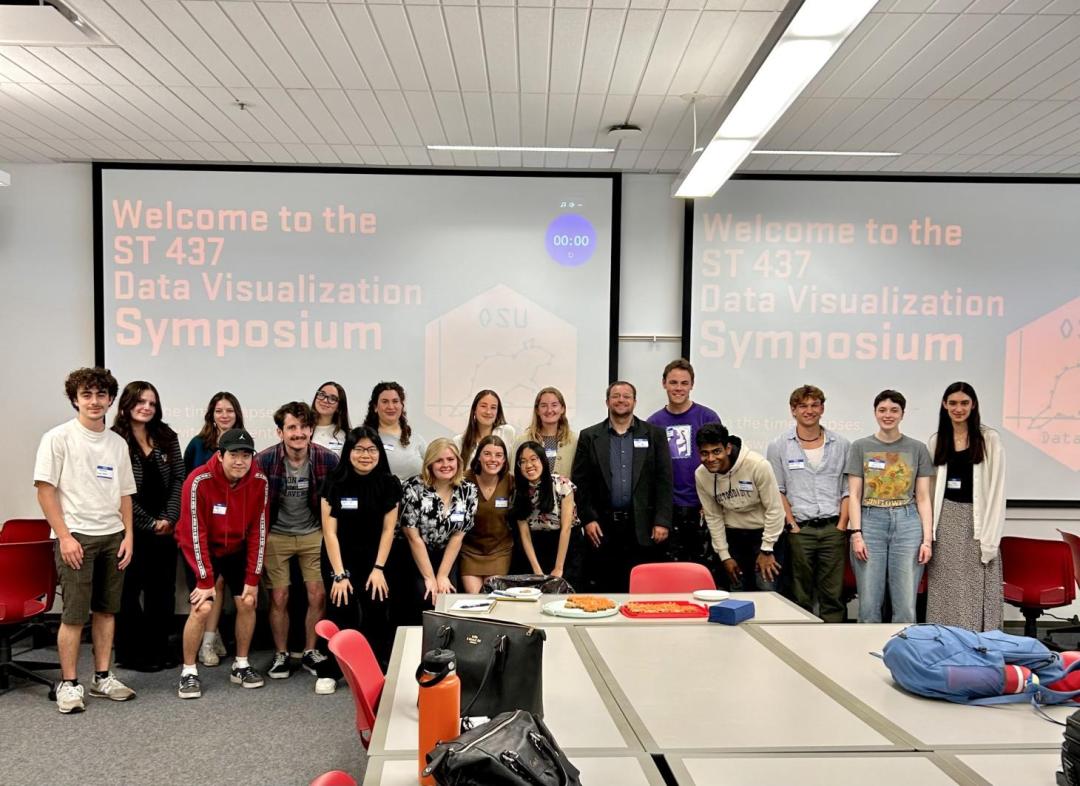
A group os students pose for a photo.

The first cohort of ST 437 gathers of the end of the year Data Visualization Symposium.

Statistics with a twist

When Howard joined the faculty in 2020, she began thinking about how to make statistics feel more creative and accessible.

“The field of data visualization focuses on putting data into a digital format that can be understood and digested by anybody. It’s about transparency in science and policy,” she said.

Howard has received several recent honors for her teaching, including the Whiteley Faculty Scholar Award, the Center for Teaching and Learning Professional Development Award, and a Best Speed Session Award from the Statistical Education Section at JSM 2024 for her presentation “Enhancing Engagement in Introductory Statistics through Student-Centered Simulations.”

The course, ST 437: Data Visualization, which is offered in spring, is open to undergraduates from across the university, not just the College of Science. Students come from mathematics, psychology, business, agriculture and biological data sciences, each bringing unique datasets from their fields.

Howard said the mix of perspectives creates a dynamic environment. “Whatever a student's major is, there’s a place for them in data visualization,” she said.

Throughout the term, students explore foundational visualization techniques before developing a major project of their choosing. They identify or collect a dataset — sometimes from research labs, sometimes from online repositories like Kaggle — and design compelling and engaging visualizations.

One student created a Shiny app displaying species diversity across U.S. national parks. Another visualized genetic data to make complex research more understandable to the public. A third student, who worked for OSU Baseball, built a project exploring team statistics.

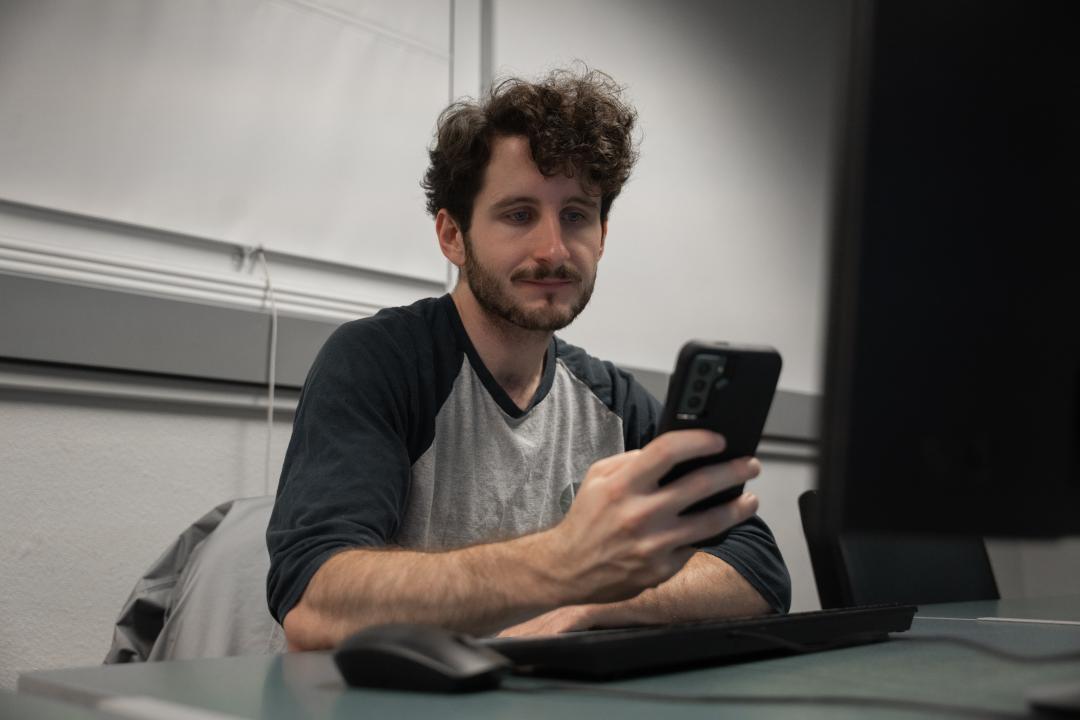
A man in a t shirt uses his cellphone.

Matthew Elcombe works on his Shiny app.

Stories in every dataset

For mathematics student Matthew Elcombe, the class became a chance to step outside his comfort zone.

A post-baccalaureate student from Santa Rosa, California, Elcombe had already earned a degree in music before returning to pursue mathematics with a statistics option. When he read about the new course, it stood out as something different.

“It seemed like a really fun course, more creative than most math classes,” he said. “I didn’t have much background in data visualization, but I liked the idea of combining analysis and design.”

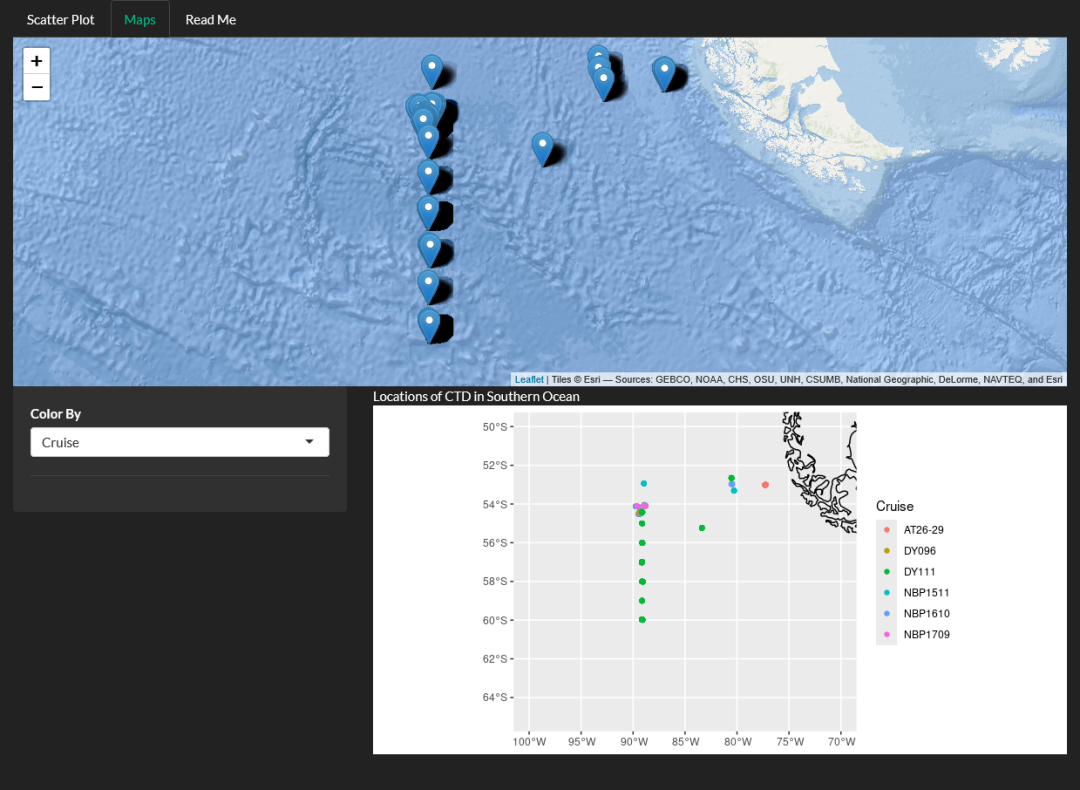
Elcombe built an interactive Shiny app using oceanography data collected off the coast of South America. The dataset measured salinity, carbon dioxide and phosphorus at different depths, allowing him to visualize how ocean conditions changed over time and space.

Screenshot of a dataset showing points on a graph.

A screenshot of Elcombe's interactive Shiny app using oceanography data collected off the coast of South America.

He learned about effective design guidelines, including Gestalt principles.

“The first thing you see on a graph is usually the most important, so you have to know how to display your data in a way that lets people immediately see a pattern — not to manipulate it, but to highlight what matters.”

The class has already opened new doors for Elcombe. He refined his class project over the summer and added it to his graduate school portfolio.

Both Elcombe and Howard had similar favorite parts of the course, the final symposium. The symposium is supposed to mimic a conference poster session, but the poster is digital. This allows the presentation to be interactive or dynamic.

The symposium happens at the end of the term in Week 10. Half the class presents while the other half listens, and then the swap.

“A lot of the students made presentations that were super in depth, and it was cool seeing how they could express themselves and what they are interested in,” Elcombe said.

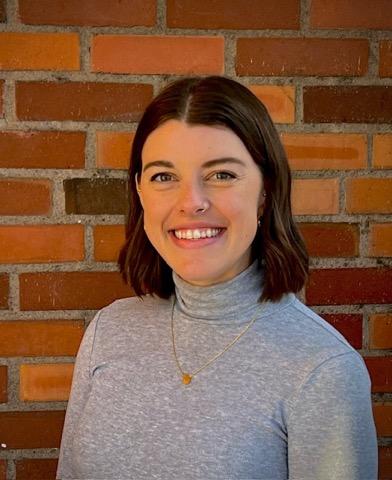
Image of Erin in front of brick wall wearing a gray shirt.

Erin Howard says the data visualization class has reminded her why she loves teaching.

Howard says the event teaches communication skills and the ability to inspect data in the real world.

“It teaches the students to scrutinize other visualizations and analyses that they see in the news and on social media. We spend time in class critiquing visualizations and noticing if anything is misleading. They learn how to look at reports and figure out what’s missing, what’s accurate or what’s not,” she said.

The class has reminded her why she loves teaching.

“One of my students told me she sent her first app to her parents,” she said. “I actually got teary-eyed. My stats students don’t usually send their parents their homework.”

Moments like that, she said, show the power of data visualization, not just to inform but to connect.

From ocean currents to baseball stats, Oregon State students are learning to use data not just to analyze the world, but to illuminate it.

Learn more about the ST 437 Data Visualization course and student projects.


Read more stories about: students, statistics, teaching innovation


Smalley smiles at the company in front of green trees.

Leader in data science curricula development wins Early Career Alumni Award

By Kaitlyn Hornbuckle

As a graduate student at Oregon State University, Heather Kitada Smalley (Ph.D., ‘18) discovered the best way to make data matter is to make it personal.

She saw it firsthand at the Oregon Museum of Science and Industry (OMSI), where a group of Girl Scouts bubbled with excitement while they explored statistics in hands-on activities and earned their science badges. As a Girl Scout alum herself, that unforgettable night captured what drives her career: helping people of all ages see themselves in science.

Now recognized with the College of Science’s 2025 Early Career Alumni Award, Smalley is redefining how data science is taught and understood. She leads the next generation of scientists as an Albaugh associate professor of statistics and data science at Willamette University. She also teaches and sets up interactive activities as an OMSI Science Communication Fellow, helping many others creatively engage with science.

At Willamette University, Smalley draws on the whiteboard to teach the two students around her about data science.

Smalley joins students at the whiteboard to learn something new. Photo by Marketing and Communications team at Willamette University.

By communicating science clearly to the public, she helps audiences of all ages — from preschoolers to grandparents — walk away with something new. “The advice I would give to students who want to teach is to remember what it's like not to know and to have understanding and empathy,” Smalley said.

By making statistics and data science relatable, she hopes to encourage young students to learn how they can use data to benefit people. She wants to help them communicate their discoveries with other communities as well. She developed this outlook when in the first cohort of the Graduate Certificate in College and University Teaching (GCCUT) program, led by Jessica Beck at Oregon State.

“I felt really supported while I was at Oregon State. They gave me a strong foundation to work with.”

That philosophy guided her first big career step in 2018, when Willamette University planned to launch a new data science program. Having just finished graduate school, the timing was perfect.

By leveraging her new education and training from Oregon State, she steered the learning outcomes in the right direction while serving as the Curriculum Committee Chair for the data science and computer science programs. After helping write a Title III grant, the Department of Education awarded nearly $2 million that supported their design of new programs from the ground up.

Today, their six years of hard work is paying off in Willamette’s brand new School of Computing and Information Science. Thanks to the program, students can pursue quality careers in statistics and data science, similar to Oregon State’s competitive statistics programs.

At Willamette University, Smalley sits on the couch with her laptop to assist other students with their data questions. Everyone in the room is wearing masks to stay healthy.

Smalley engages with students when in-person classes returned in 2021. Photo by Marketing and Communications team at Willamette University.

“I use multiple modalities of teaching so that statistics and data science isn’t super theoretic and abstract,” Smalley said. “I always have hands-on components where students are engaging in skill building.”

A student-centered approach to teaching

Smalley’s teaching career took off earlier than expected. While completing her doctorate degree in statistics at Oregon State, she landed a position as visiting assistant professor of statistics at Reed College in Portland. She taught classes at both institutions; some online at Oregon State and others in-person at Reed.

“I felt really supported while I was at Oregon State. They gave me a strong foundation to work with,” Smalley said. “When I'm designing curriculum, I am always thinking about the student experience and what's going to help motivate them to learn this topic.”

For Smalley, the community at Oregon State opened new doors, led to lifelong friends and helped her become the kind of professor she always wanted to be. Her advisor, Sarah Emerson, mentored her throughout graduate school, leaving her with advice that continues to influence how Smalley teaches and conducts research today.

“Several people I know went into higher education to be those professors that wanted to change people’s lives. Having that in common ties us together,” she said. “We are connected because we were in Corvallis together, and I think there’s something really powerful about that.”

At Willamette University, Smalley joins two other students at the couch to discuss any questions about the exercises on their laptops. Everyone in the room is wearing masks to stay healthy.

Smalley sits down to explain new concepts in statistics and data science. Photo by Marketing and Communications team at Willamette University.

Smalley’s teaching and curricula stands out because she keeps teaching pedagogy at the center. Rather than losing students’ attention with extensive and abstract equations, she focuses on the bigger picture. By using diagrams and interactive visuals, students can better understand exactly how and why those equations work rather than root memorization.

“I want my students to feel empowered to use data to understand the world around them. Being a statistician doesn't mean you memorize all the statistics ever created. It's about data literacy,” Smalley said. “It's about asking questions and looking for patterns. You don’t have to memorize equations if you know how something works.”

With great conferences, comes great opportunities

To make the learning experience even more intriguing, Smalley is taking her research to the next level. In the past, she used to be knee-deep in analyzing the data quality of public opinion research. But after a meeting with Scott Pike, professor of environmental science and archaeology at Willamette, she’s going in a new direction.

Now, she’s involved in groundbreaking research — literally. She’s interpreting decades-worth of data collected on a variety of stones, including marble isotopes in Greece and geochemical soil analysis samples from the Ness of Brodgar in Scotland. To help support the next generation of scientists, she loves to include her students in on the fun.

“The students that I'm working with on these projects are amazing. I'm working with a student that is presenting that research next week at a conference,” Smalley said. “I’m really excited about it because I love helping people with their data.”

Smalley smiles while holding a green bucket and standing next to a statistics target practice board lined with four colorful targets. The workshop is part of an event with the Oregon Museum of Science and Industry (OMSI).

Smalley gamifies statistics using a board for target practice at an OMSI event.

The cherry on top of her professional career is presenting research at domestic and international conferences. Last summer, she attended the European Survey Research Association (ESRA) conference in the Netherlands, where she connected with professionals whose work she had long admired.

Smalley also loves to attend the American Association for Public Opinion Research (AAPOR) conference. There, she saw students blossom and build their network for the first time. Every year since 2022, she brings students along so that they have the experience of meeting and presenting to professionals in the field, just like she did.

To prepare them well, she has been mentoring students in the Science Collaborative Research Program (SCRP) at Willamette University every summer since 2022. After students spend the summer doing research, they communicate their findings at a regional conference.

Collaborating with students on research and watching them present during their poster sessions make the entire experience valuable. “I love taking that moment to step back and just watch the students shine. It makes me really emotional to think about because I just feel so proud of them,” Smalley said.

Conferences like these help bring scientists together that wouldn’t otherwise meet. She kept in touch with professionals from the U.S. Census Bureau and is often invited to collaborations with other data scientists. These opportunities not only accelerate her career, but those of young scientists as well.

When she’s not teaching in the classroom, she is assembling interactive science displays and proudly communicating what matters most as an OMSI volunteer, for nearly a decade and counting. Outside of teaching, Smalley is a proud mother of two, busy making the world a better place for her family of Beaver fans.

A laurel leaf icon with a scroll, surrounded by a border of snowflakes.

2021-22 College of Science awards: Celebrating excellence in teaching and advising

By Grace Peterman

On February 22, the College of Science gathered to recognize academic, administrative and teaching excellence at the 2021-22 Combined Awards Ceremony. The first portion of the ceremony celebrated research and administrative achievements, while the second highlighted outstanding teaching, advising and mentoring.

The College celebrates the Teaching and Advising Awards winners below for their deep commitment to engaging with the student experience and application of mentoring and advising expertise to ensure student learning and success within and beyond the classroom. Effective teaching, advising and mentorship are the very heart of the College of Science’s identity as a robust and thriving community of students and scholars. Driven almost exclusively by students’ nominations, these awards are an opportunity for our community to express gratitude and appreciation for each other.

2022 Teaching, Advising and Mentoring Award Winners

Olaf Boedtker Award for Excellence in Academic Advising

Rachel Palmer, a woman with long hair, smiling.

Integrative Biology Advisor Rachel Palmer

Rachel Palmer, integrative biology advisor, won the Olaf Boedtker Award for Excellence in Undergraduate Advising for her tireless support, efforts and advocacy on behalf of undergraduate students. This award was established in 1988 in honor of Olaf Boedtker, a professor in the Department of Physics who served as Head Advisor in the College from 1973 to 1987. While at Oregon State, he provided exceptional service to students and to the College.

Several students nominated Palmer for this award, praising her dedication and ability to connect and encourage students to achieve their goals.

One student nominator wrote of Palmer: “Right off the bat, Rachel came across as a very happy-go lucky person. She has always been extremely kind and caring at every meeting, treating me as an equal adult and even cracking some jokes that set me at ease. She has always been able to answer every question I had, no matter how specific or vague. I can absolutely tell she wants to help me and set me on the best path possible. Rachel pays mind to each and every student as an individual. She is passionate, inspirational, dedicated and she really knows her stuff!”

Another student had similar feedback for Palmer: “Rachel has made the beginning of my journey towards my Bachelors of Science in Zoology a wonderful experience even through uncertainty. She really goes above and beyond the call of duty, you would not think an advisor could be such a hero.”

“I admire how easily Rachel has helped me find a class schedule that works so well," wrote another student nominator. "She asks important questions, listens to your expectations and executes. One thing she does well is helps me find classes that work well together as far as content.”

Additional nominees for the Olaf Boedtker Award included:

  • Cody Duncan, advisor for integrative biology
  • Allison Evans, instructor of microbiology
  • Jen Olarra, advisor for biology
  • Kari Van Zee, senior instructor of biochemistry and biophysics

Loyd F. Carter Award for Outstanding and Inspirational Teaching (Undergraduate)

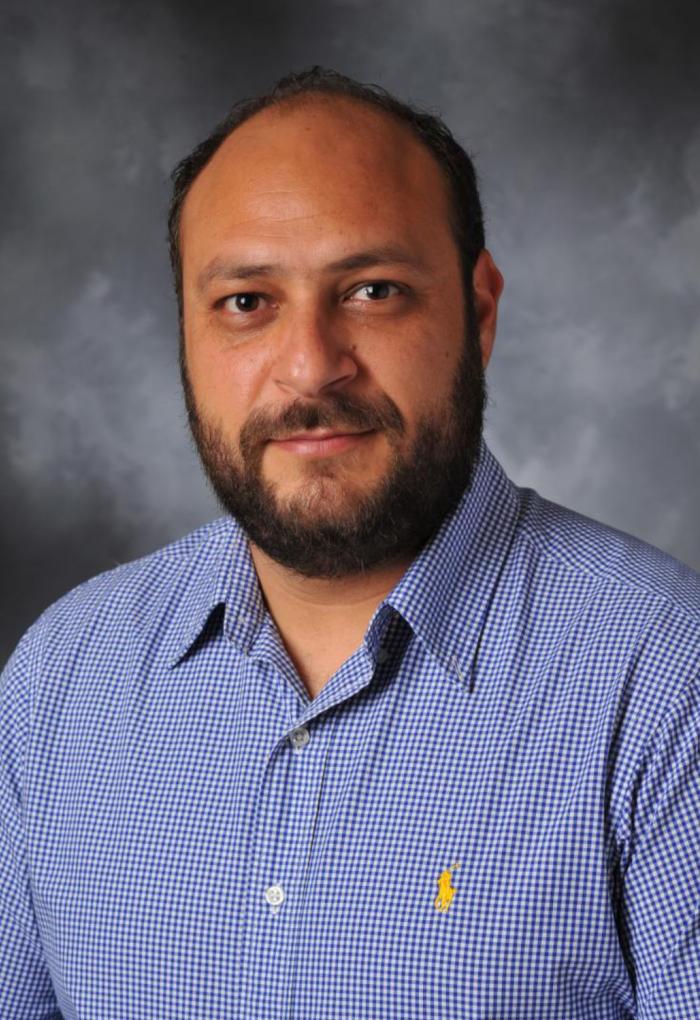
Kyriakos Stylianou, a man with a beard.

Assistant Professor of Chemistry Kyriakos Stylianou

This year’s Loyd Carter Award for Outstanding and Inspirational Undergraduate Teaching in Science goes to Kyriakos Stylianou, assistant professor of chemistry.

Every year since 1946, the Loyd F. Carter Award has been presented to two outstanding College of Science faculty members: one for undergraduate teaching and one for graduate teaching. The purpose of the award is to encourage and recognize effective and inspirational teaching. The final selection is based solely on student nominations and voting.

Stylianou’s students describe him as passionate, inspirational and dedicated. “This man is so incredibly intelligent but also one of the humblest people you will ever meet,” one student said.

“He has to be one of the best professors I have had here at OSU,” said another student nominator. “Walking into CH 233, I was super nervous. I heard it was the hardest of the chemistry series. With everyone feeling the burnout of virtual learning, he made sure to make his class engaging and put everything he had into every class.”

Many students praised the learning atmosphere Stylianou creates in his classes and his attentiveness to student needs. “He cares very much about his students and wants to see them succeed. He devotes a significant amount of time inside and outside of class to give them the opportunities and resources they need to be successful in his class, and beyond. He never tries to beat around the bush, always gives you an honest answer, and just wants to see the best in people. The jokes and wise-cracks in class always help to lighten the mood as well.”

Additional nominees for the Loyd F. Carter undergraduate award included:

  • Daniel Myles, senior instructor of chemistry
  • Devon Quick, senior instructor of integrative biology
  • Marita Barth, instructor of chemistry
  • Malcolm Lowry, assistant professor of microbiology
  • Nathan L. Kirk, senior instructor of integrative biology
  • Paul Cheong, associate professor of chemistry
  • Phil McFadden, associate professor of biochemistry and biophysics
  • Scott Geddes, instructor of chemistry
  • Stacey Vaughn, instructor of mathematics

Loyd F. Carter Award for Outstanding and Inspirational Teaching (Graduate)

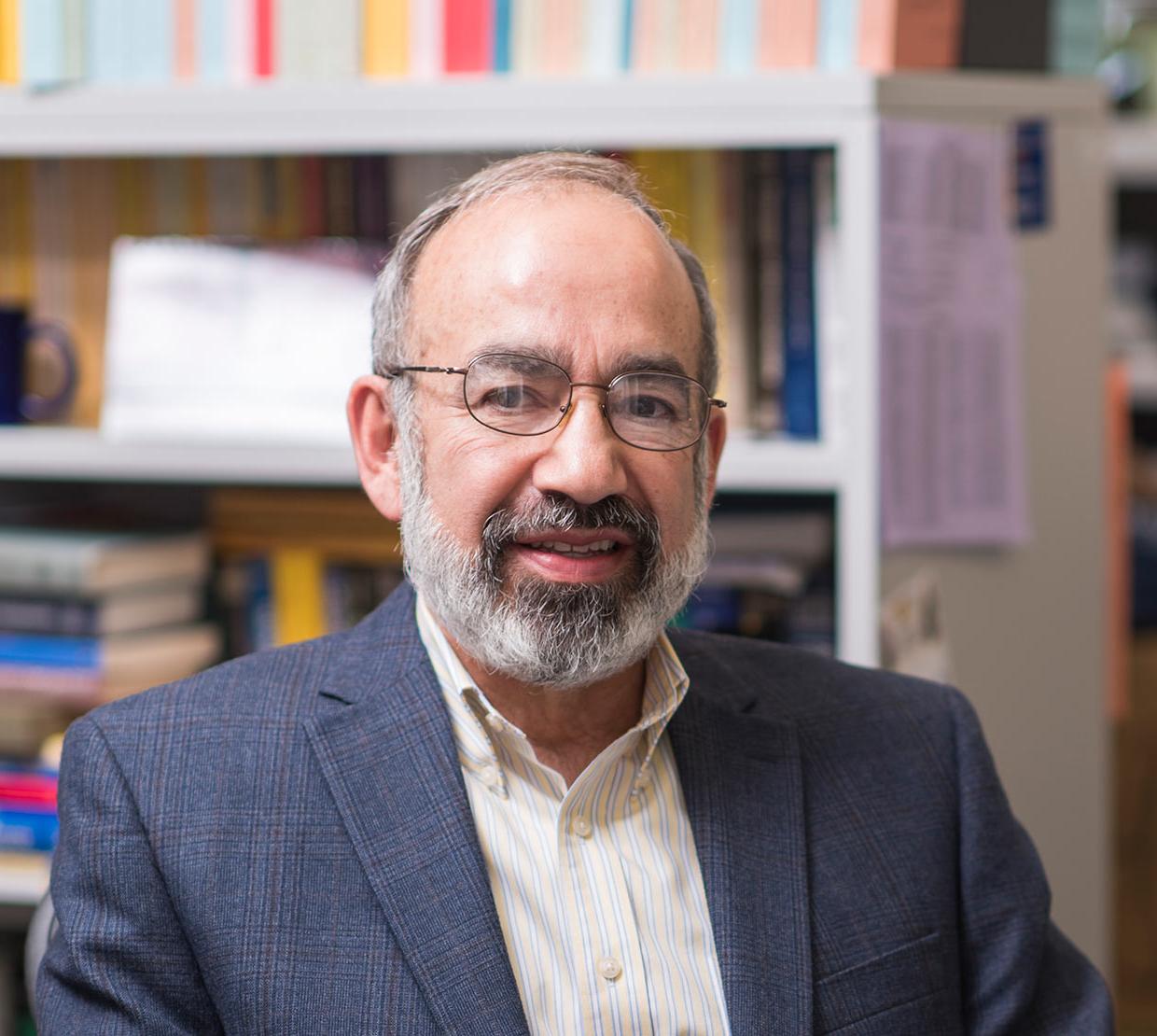
James Molyneux, a man with a beard.

Assistant Professor of Statistics James Molyneux

This year’s Loyd F. Carter Award for Outstanding and Inspirational Graduate Teaching in Science goes to James Molyneux, assistant professor of statistics.

Students nominating Molyneux described him as caring, uplifting and welcoming, and praised his ability to adapt during the pandemic. "He consistently encouraged me and my cohort during the transition from COVID to campus, to keep up our spirits in one of the most difficult academic years of our lives," said one student. "Without him, I would not have gathered the courage to continue moving forward. He is brilliant in the classroom as a professor and a loyal mentor and advocate for our success."

Another student said the following of Molyneux: "He excels at making statistics, a subject which is generally taught dryly and without much passion, relevant to grad students' research and our daily life. He uses timely examples and highlights the nuance of stats, in a way that makes it fascinating instead of frustrating. He was always available for extra help or assistance outside of class, and always seemed willing to discuss other topics than just the class material! He is supportive and compassionate with graduate students, and was the best stats teacher I've had so far at OSU! He also made sure the class content was accessible to students in multiple ways by recording both Zoom and in-person classes, and making the lecture notes easily available. His high-energy and engaging teaching style was apparent in both the in-person and online class I took with him, which I have found to be a rare occurrence in a remote setting!"

Thomas Sharpton, associate professor of microbiology, was also nominated for the Loyd F. Carter graduate award.

Frederick H. Horne Award for Sustained Excellence in Teaching Science

Liz Gire, a woman smiling.

Associate Professor of Physics Elizabeth Gire.

This year’s Frederick H. Horne Award for Sustained Excellence in Teaching Science goes to Liz Gire, associate professor of physics.

This award honors Fred Horne, who served as Dean of Science at Oregon State from from 1986 to 1999. Fred passed away in 2021, a renowned researcher, scholar, teacher and leader.

Fred exemplified the values of our college, embracing a deep commitment to diversity, equity and inclusion in science. He was instrumental in establishing two programs that encourage students of color to pursue and continue their education in science, math and engineering: Science and Math Investigative Learning Experience (SMILE) and the American Indian Science and Engineering Society (AISES).

The purpose of this award is to recognize sustained excellence in teaching science by honoring a faculty member in the College of Science who has repeatedly demonstrated exceptional instructional qualities and has had a significant impact on students over a period of not less than five years.

Liz Gire has earned this award through her tireless dedication to support the holistic student experience. A plethora of students and colleagues wrote at length in support of Gire's nomination. One student nominator said, "Her level of dedication to the genuine support and inclusion of the students in her courses is something I’ve never seen in an educator before. She backs that up with her skill and experience in education and communication that makes difficult content still accessible and enjoyable to learn. She takes every opportunity to build others up, whether that be her students, her teaching team, her research partners or the many people in our department who aren’t any of those things, but still know they can come to her because she is the type of person who will help however and whenever she can."

Another student nominator said, "Liz is a wonderful professor because she is a master at reading the atmosphere of a classroom. Sure, part of this is an intuition that comes from experience, but more importantly, she takes time to ask questions. Each student is expected to grab a small white board and marker at the beginning class. Later when Liz looks out and says, 'write down something that you know about angular momentum' she can measure students’ level of confusion and use student responses to guide the classroom discussion. This makes everyone much more willing to participate in class because they know that she honestly cares for their well-being and success."

Congratulations to all the winners and all the nominees!

A nighttime sky with an award sign overlaid on top

2020-21 College of Science awards: Celebrating excellence in teaching and advising

By Cari Longman

On April 22, the College of Science gathered virtually to recognize academic, administrative and teaching excellence at the 2020-21 Combined Awards Ceremony – a merge of our annual Faculty and Staff Awards and Teaching and Advising Awards events.

The first half of the ceremony celebrated excellence in research and administration, and the second half the ceremony focused on outstanding teaching, advising and mentoring,

The College congratulates the Teaching and Advising Awards winners below who exemplify deep commitment, skill and effectiveness in mentoring and advising to ensure student learning and success within and beyond the classroom. Effective teaching, advising and mentorship are the very heart of the College of Science’s identity as a robust and thriving community of students and scholars.

Congratulations to all the nominees and especially to the award winners.

2021 Teaching, Advising and Mentoring Award Winners

Olaf Boedtker Award for Excellence in Academic Advising

Tiffany Bolman

BioHealth Sciences Advisor Tiffany Bolman

Tiffany Bolman, biohealth sciences advisor, won the Olaf Boedtker Award for her tireless support, efforts and advocacy on behalf of undergraduate students. Olaf Boedtker was a former professor in the Department of Physics for 23 years and served as head advisor in the College for 14 years from 1973 to 1987. This award recognizes exceptional and inspirational undergraduate advising.

More than ten students nominated Bolman for this award, praising her dedication and ability to connect and encourage students to achieve their goals.

One student nominator wrote of Bolman: “During one of the hardest years of my life, I met my new advisor, Tiffany. Changing your advisor in the middle of your junior year can be stressful. The first time I met her, my meeting lasted almost two hours because we spent time getting to know each other and talking about life. The way that Tiffany has been here to support me is incredible – as an advisor, a mentor, a friend and a support system. She's helped me in countless ways this past year, not just for school and for my future, but personally. I know I would not be where I am right now without her.”

“Tiffany has guided me in my fast-paced college experience and is always courteous when I talk to her,” wrote another biohealth science student nominator. “She has provided ample opportunities for me to get involved in health care and shadowing, even during Covid-19, in order for me to be a competitive applicant for medical school. I feel as though Tiffany wants the best for all of her students, including myself, and her heartwarming encouragement never lets me down.”

Another student had similar praises for Bolman. “I transferred to Oregon State and [Tiffany Bolman] was the first faculty member I had any interactions with. She seems to truly care about the future of the students she is advising and is overall an amazing person to talk to.”

Additional nominees for the Olaf Boedtker Award included

  • Allison Evans, instructor of microbiology
  • Kari Van Zee, senior instructor for biochemistry and biophysics
  • Maureen Leong-Kee, advisor for integrative biology
  • Vince Remcho, professor of chemistry

Loyd F. Carter Award for Outstanding and Inspirational Teaching (Undergraduate)

Corinne Manogue

Professor of physics Corinne Manogue

Professor of physics Corinne Manogue won this year’s Loyd F. Carter Award for Outstanding and Inspirational Teaching in Science. Manogue teaches the nationally-recognized Paradigm in Physics courses, which are a restructuring of the traditional upper-division curriculum for physics students to a more modern, flexible and inclusive model for learning physics.

Student nominees cited Manogue’s extra efforts to ensure her students understand content, her ability to teach complex topics, and her compassion with her students in an especially tiring year.

“She is an outstanding teacher who really works to understand how her students are approaching the material and provides numerous ways for the students to actively engage with the content,” wrote one student nominator. “She is very aware that each student has a different learning style and that content needs to be restated multiple ways and in multiple forms and that each version will resonate differently with each student.”

Other student nominators had similar praises for Manogue. "She is truly fantastic at explaining complex topics in ways that relate them to us students, and it was often that many would exclaim how well they understood ideas and techniques significantly better after having an explanation from her in class," said one nominator, and another added: "Corinne convinced me that there weren't such things as 'STEM people' and that success in STEM was available to me and other students who like me had been dissuaded by a perception of being inherently 'not smart enough' to become physicists."

Manogue has received recognition at multiple levels – Oregon State University, the state of Oregon and nationally – for her teaching excellence and has previously won a number of awards recognizing her teaching excellence, including the College of Science Frederick H. Horne Award for Sustained Excellence in Teaching in 2000, an American Association of Physics Teachers Award for Excellence in Undergraduate Physics Teaching in 2008, and the 2016 Oregon Academy of Science Outstanding Educator in Science and Mathematics award.

Additional nominees for the Loyd F. Carter undergraduate award included

  • Daniel Myles, senior instructor of chemistry
  • Daniel Rockwell, senior instructor of mathematics
  • Devon Quick, senior instructor of integrative biology
  • Kimberly Halsey, associate professor of microbiology
  • Linsday Biga, senior instructor of integrative biology
  • KC Walsh, senior instructor of physics

Loyd F. Carter Award for Outstanding and Inspirational Teaching (Graduate)

Charlotte Wickham with a black background

Senior Instructor of statistics Charlotte Wickham

Senior Instructor of statistics Charlotte Whickam received the Loyd Carter award for her inspirational and superb mentorship and teaching of graduate students.

“Charlotte is an extremely talented statistician and teacher. You can tell she is extremely passionate about the things she teaches and is invested in her students learning. She is also very approachable, despite teaching an online course,” wrote one graduate student nominator. “The material I have learned in her class has been useful and applicable to all of my work as a statistician,” they added.

“Dr. Wickham really took the time and got involved with my term project topic. She understood my skill level and was really great on providing feedback,” wrote another nominator.

A specialist in R training, Wickham teaches courses in data visualization and the foundations of data analytics. In 2020 Wickham received the Oregon State Ecampus Excellence in Online Teaching and Student Engagement Award. Wickham has developed multiple Ecampus courses built around students and their learning, leveraging open source materials and engaging texts from the Valley Library at Oregon State University.

Frederick H. Horne Award for Sustained Excellence in Teaching Science

Senior Instructor for biochemistry and biophysics Kari Van Zee

Senior Instructor for biochemistry and biophysics Kari Van Zee

Senior Instructor for biochemistry and biophysics Kari Van Zee won the Frederick H. Horne Award for her exceptional qualities as a teacher and mentor. This award is named after Fred Horne, OSU Professor Emeritus of Chemistry and the former College of Science Dean for 13 years, from 1986 to 1999.

Kendra Jackson (’20, biochemistry and biophysics), praised Van Zee in her nomination letter, writing, “Kari made a great impact on my education at OSU and has empowered me to be an independent learner.”

Jackson interacted with Van Zee as a student, mentee, teaching assistant and advisee. She added in her letter that “Kari is compassionate and deeply cares about the well-being of her students.” This quality was especially apparent during the 2020-2021 school year with remote learning. “Kari constantly checked up on struggling students in each section, offered solutions for students who could not access technology or adequate study spaces, and adapted the class based on student feedback.”

Tanushri Kumar, a 2020 biochemistry graduate and Ph.D. student at the University of Washington, also wrote a nomination letter. She praised Van Zee’s personal connection with her students: “Kari is a fantastic teacher, a scholar, and a devoted mentor to all her students. It is truly rare to find a teacher as talented and as compassionate as she is. Without her guidance, I would have never discovered my own passion for research, and without her support I would not have had the courage to apply for graduate school. The impact she has had on my life has been huge, and I am incredibly grateful for having her as a mentor and instructor.”

College of Science Whiteley Faculty Scholar for Teaching Excellence Award

Devon Quick

Senior Instructor of integrative biology Devon Quick

Senior Instructor Devon Quick in the Department of Integrative Biology received this award which recognizes excellent teaching and learning innovation. This award will provide Quick with an annual stipend of $12,500 for three years.

Widely commended for her teaching of biology, human anatomy and physiology courses, Quick has received awards for her exceptional teaching in the past. In 2020, she received the Loyd F. Carter Award, and in 2016 she received university-wide recognition by receiving the OSU Faculty Teaching Excellence Award.

Quick is a co-founder of the Learning Assistants Program, which puts high-achieving undergraduate assistants in large enrollment, often first-and second-year STEM classrooms to facilitate and strengthen undergraduate learning. She also collaborated with fellow biology instructor Lindsay Biga to adapt an open source biology textbook that is freely accessible to OSU students and learners worldwide.

OSU Faculty Scholars for Teaching Excellence Award

KC Walsh

Physics instructor KC Walsh

Physics instructor KC Walsh won the Faculty Scholars for Teaching Excellence Award. This award for a three-year faculty scholar position supports excellence and innovation in teaching and carries an annual stipend of $12,500.

Walsh helped to transform OSU’s introductory physics classes by reversing the traditional learning environment. In flipped classrooms, students receive course content online outside of the classroom, freeing up classroom time for active learning. He then pioneered the flipped classroom in the online environment long before the pandemic forced all instructors and faculty to adjust to all-online teaching. The results of the flipped classroom model have been dramatic: the withdraw rate from introductory physics class dropped from 36 percent to only 12 percent with a marked increase in course satisfaction.

Walsh previously received the OSU Faculty Teaching Excellence Award for his significant and meritorious achievement in teaching and scholarship that enhances effective instruction. And in 2018, the Department of Physics received the American Physics Society (APS) Award for Improving Undergraduate Physics Education, due in part to Walsh’s pioneering flipped classrooms and his early use of online resources to increase student success.

The OSU and Whiteley Faculty Scholars for Teaching Excellence awards are made possible thanks to the generous philanthropic support of our alumni and friends and matching funds invested by the Provost’s Office.

Read more about the winners of the 2020-21 graduate and undergraduate research and administration awards.

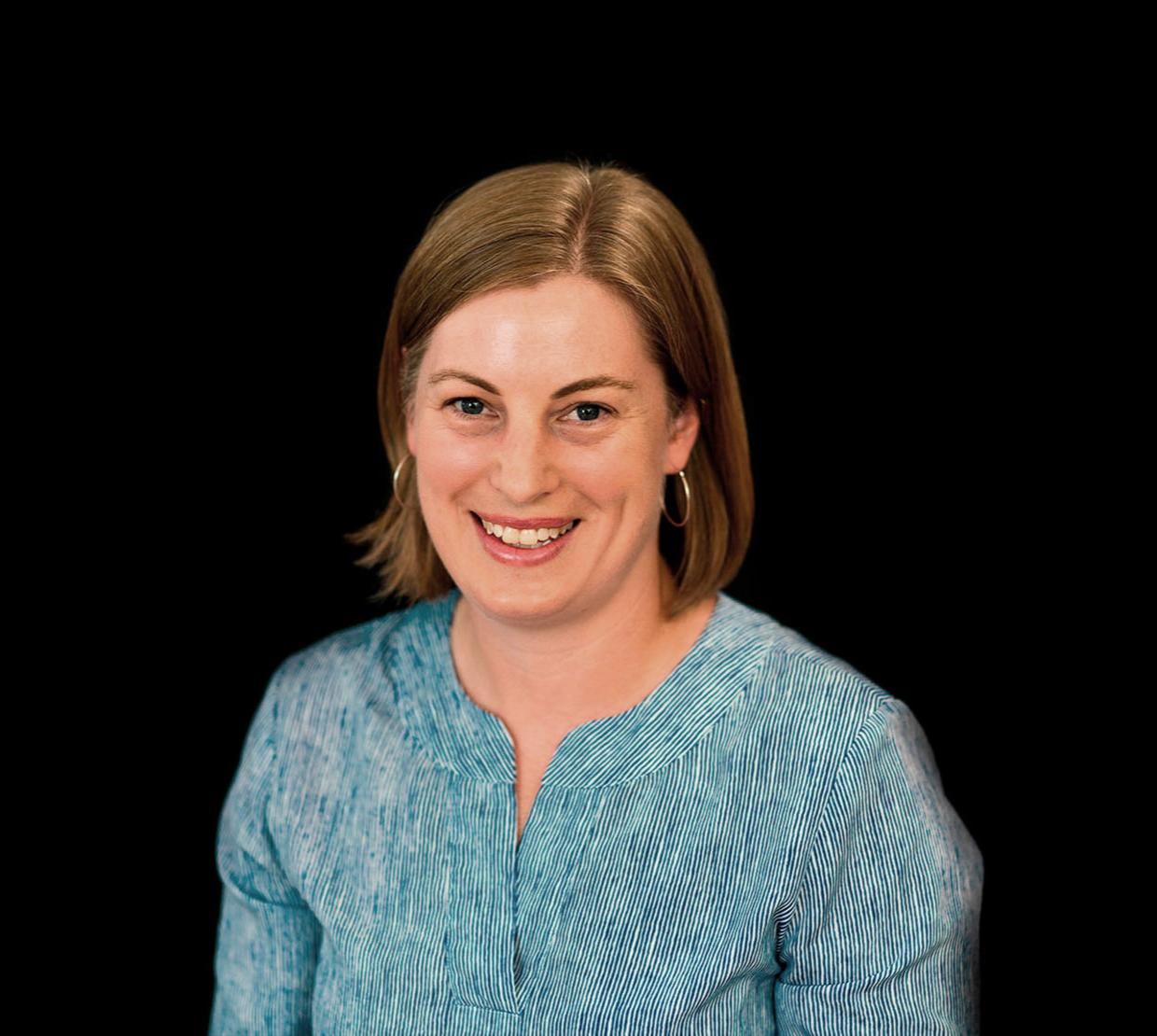
Charlotte Wickham standing in front of black backdrop

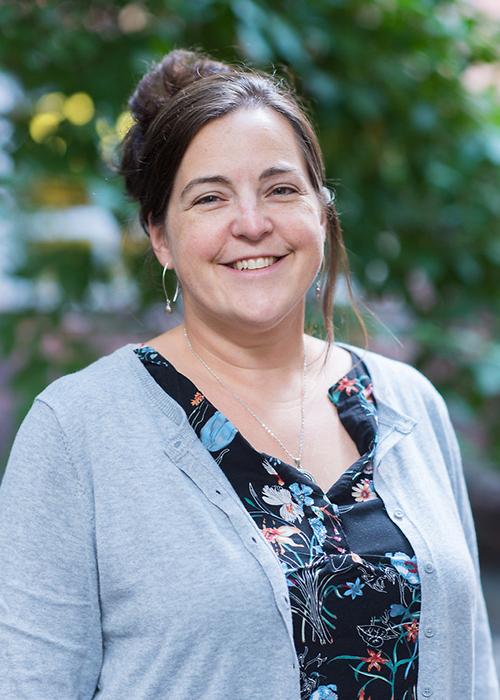
Statistics assistant professor receives Ecampus award for teaching excellence

By OSU Ecampus

Charlotte Wickham, Assistant Professor in the Statistics Department

The College of Science is proud to congratulate Charlotte Wickham, an assistant professor in the statistics department, for receiving the 2020 Ecampus Excellence in Online Teaching and Student Engagement Award. In a non-remote world, Charlotte would have received the award in a ceremony in the Alumni Center. In lieu an awards ceremony, please join us in congratulating her for making a difference for students and their education.

The fourth annual Oregon State University Ecampus Awards recognize outstanding faculty partners who go the extra mile to develop meaningful and innovative online learning environments for OSU’s distance students. Each winner is an exceptional partner of OSU’s Ecampus, a change-maker in the lives of distance students and a leader in the field of online education.

Charlotte Wickham, an assistant professor in the in the Department of Statistics in the College of Science, is one of three OSU faculty who have received this award. Wickham has developed multiple Ecampus courses built around students and their learning, leveraging open source materials and engaging texts from the OSU Library. Student nominations focused on several key areas, including Charlotte’s engagement in student discussions and her encouragement of experimentation, even if that approach requires more individualized time and feedback in facilitation.

One student noted “I never felt like I needed to rein in an assignment and only do just what was required when I really wanted to run with an idea. … That’s great teaching.”

Another student pointed out her thorough organization and the passion that goes into the development of each of her Ecampus course. Charlotte approaches her students with enthusiasm, and students leave her classes excited about statistics and prepared to take on today’s data-driven environment.

The 2020 Ecampus Excellence in Online Teaching and Student Engagement Award recognizes three faculty members who exemplify excellence in online teaching and student engagement. Ecampus faculty and instructors are nominated for this award by current online students. This year, 284 students nominated more than 140 faculty and instructors for this award.

Laurel and diploma on dark background

Celebrating teaching and advising excellence

By Cari Longman

The College of Science celebrated its 2020 Winter Teaching and Advising Awards with faculty, advisors and students on February 13 to recognize exceptional teaching and advising, both areas of distinction in the College. Committed and effective teaching, advising and mentorship are at the very heart of the College of Science’s identity as a robust and thriving community of students and scholars.

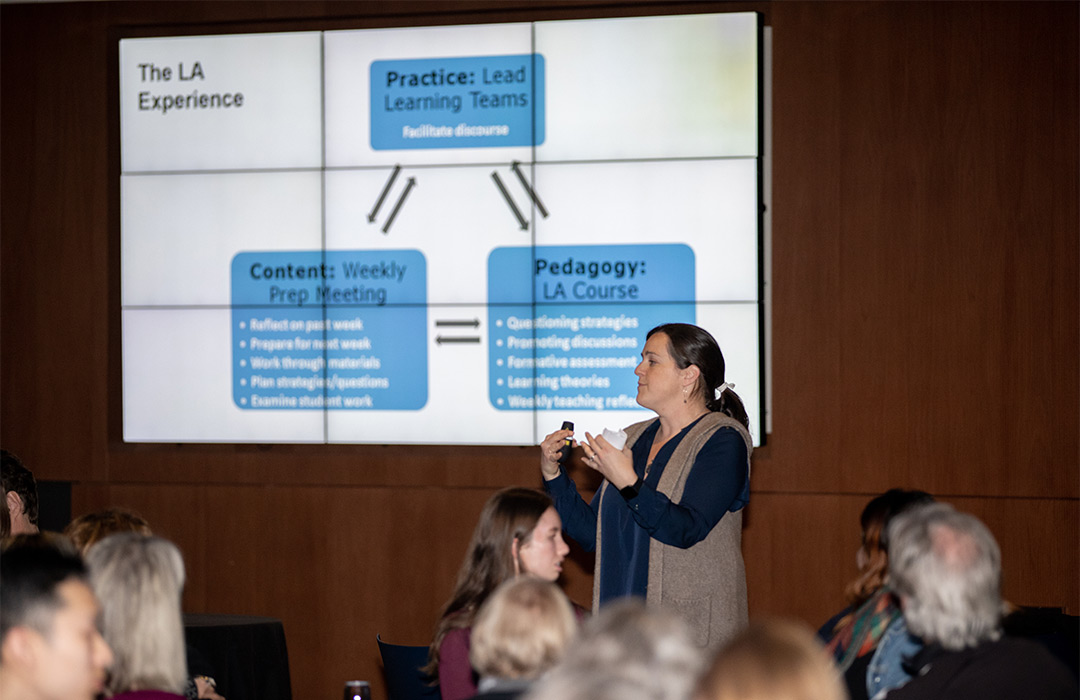
The awards ceremony included an engaging presentation by the Learning Assistants program, which puts high-achieving undergraduate assistants in large enrollment, often first-and second-year STEM classrooms to facilitate and strengthen undergraduate learning. Over the past five years, the LA program in the College of Science has reduced the drop-fail-withdrawal (DFW) rate in several key courses by half, and has now become a model for other colleges in the university.

“Our faculty are not only leaders here at OSU, but also across the nation and around the world. We celebrate our award recipients today for the incredible difference they have made in students’ lives,” said Dean Roy Haggerty, emcee for the ceremony, in his opening remarks.

Dean Haggerty recognized two faculty members at the beginning of the ceremony. Virginia Weis, Head of the Department of Integrative Biology and OSU Distinguished Professor, was named the new Dr. Russ and Dolores Gorman Faculty Scholar. The three-year rotating award recognizes faculty who bring distinction to the College of Science, connect with industry, and have a strong record of innovative research with practical impact. He also announced Elisar Barbar as the new head of the Department of Biochemistry and Biophysics and thanked Andy Karplus for his service as department head from 2007 to 2011, and then again from 2015 to January 2020.

Congratulations to all the nominees and especially to the award winners. The award recipients exemplify deep commitment, skill and effectiveness in mentoring and advising to ensure student learning and success within and beyond the classroom.

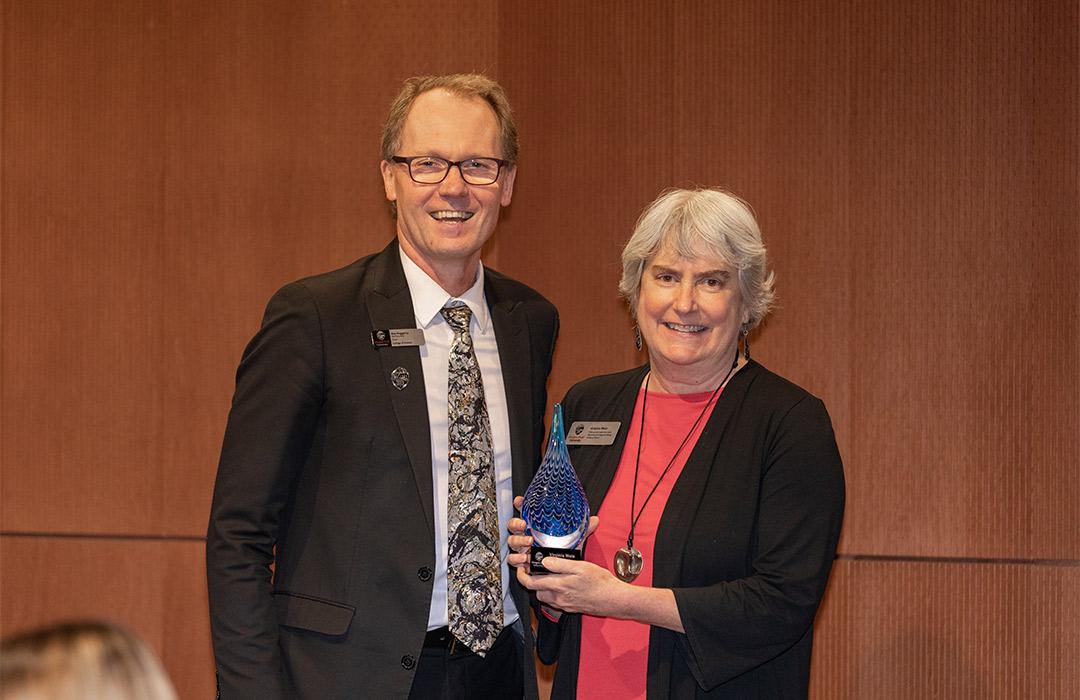
Virginia Wes receiving an award from Dean Haggerty

Dean Haggerty (left) with Distinguished Professor of Biology Virginia Weis (right), who received the Dr. Russ and Dolores Gorman Faculty Scholar award

2020 Award Winners

Olaf Boedtker Award for Excellence in Academic Advising

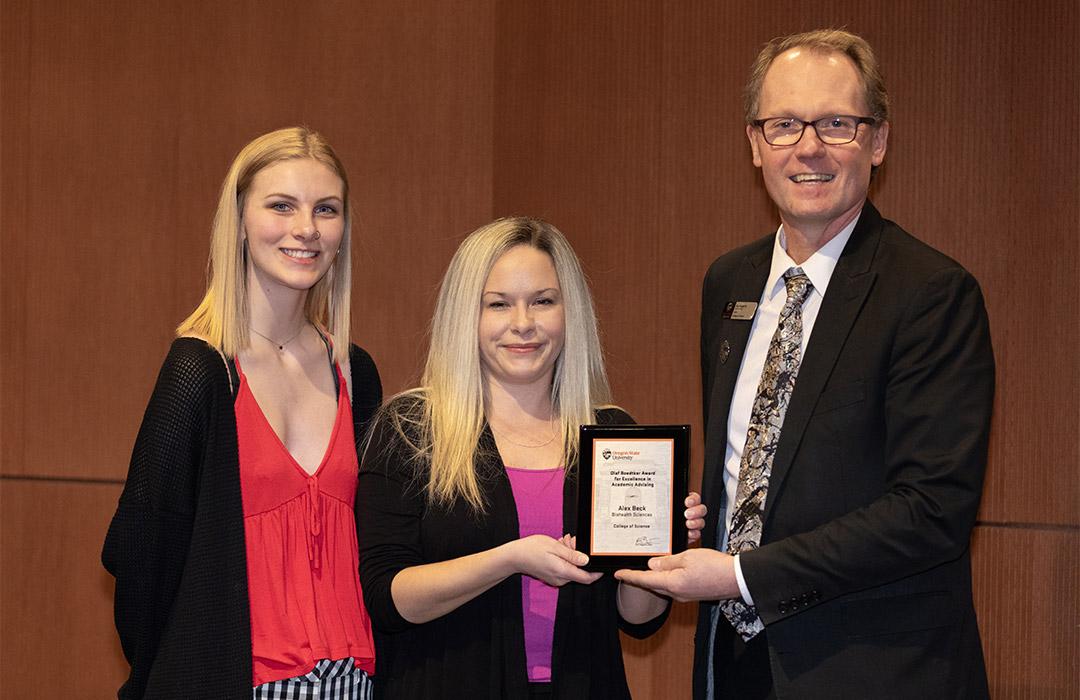
Alex Beck, BioHealth Sciences advisor won the Olaf Boedtker Award for her tireless support, efforts and advocacy on behalf of undergraduate students. The award, which encourages and recognizes exceptional and inspirational advising of undergraduates, was presented by Jayden Rummell, a biohealth sciences student.

“Alex is a phenomenal advisor, confidant and friend. She has helped me in a way that no other advisor has,” said Rummell. “She always makes time to meet with me, even when I don’t have an appointment and I just drop by for a quick chat. She is by far the most motivating person I have in my life,” she added.

Another student nominator had similar praises for Beck: “Whenever I have doubts about my classes, degree or career path, she is there to reassure me that I am on the right track and that I am capable. Never have I met someone so patient and kind, but also so genuine. After getting to know her as not only an advisor, but as a person, I wholeheartedly believe that Alex is the most deserving of this award.”

Other nominees for the Olaf Boedtker award included: Adel Faridani, mathematics; Allison Evans, microbiology; Bo Sun, physics; Christine Pastorek, chemistry; Corinne Manogue, physics; David Lazzati, physics; Shawn Massoni, biohealth sciences; Enrique Thomann, mathematics; Janet Tate, physics; Jen Olarra, biology; Kari van Zee, biochemistry & biophysics; Linda Bruslind, microbiology; Margie Haak, chemistry; Mas Subramanian, chemistry ;Neal Sleszynski, chemistry; David McIntyre, physics; and Paul Blakemore, chemistry.

Biohealth sciences advisor Alex Beck posing with award with biohealth sciences student Jayden Rummell (left) and Dean Haggerty (right)

Biohealth sciences advisor Alex Beck (center) with biohealth sciences student Jayden Rummell (left) and Dean Haggerty (right)

Loyd F. Carter Award for Outstanding and Inspirational Teaching (Undergraduate)

Senior Instructor Devon Quick in the Department of Integrative Biology and Learning Assistants Program co-founder won this year’s Loyd F. Carter Award for her excellent teaching of biology, human anatomy and physiology courses.

Arisa Larmay, a microbiology undergraduate, presented Quick with her award. “She incorporates many learning styles and makes the course and content engaging and interesting,” Larmay said, adding, “She makes her students feel welcome and is always enthusiastic about the course.”

Other student nominators had similar praises for Quick:

  • “She has an excellent ability to get students thinking deeper about a subject and helps students formulate knowledge in a logical manner.”
  • “Devon goes above and beyond to ensure that students have an appropriate understanding and appreciation for class concepts. She really puts her heart and soul into class and it shows.”
  • “She wants each and every one of her students to succeed and actually cares that we’re learning the material.”
  • “She always helps us connect intersections between the hard science we are learning with its social and public health applications, without fail. She is incredibly thorough and plants seeds in our minds of how to be not just knowledgeable, but culturally and emotionally sensitive health care professionals.”

Congratulations, Devon! Thank you for your dedication and hard work to prepare our future science leaders and health care professionals.

38 faculty members were nominated for this award. Other nominees with multiple nominations include Adel Faridani, mathematics; Kevin Gable, chemistry; Nathan Kirk, biology; Malcolm Lowry, microbiology; Ethan Minot, physics; Daniel Myles, chemistry; Richard Nafshun, chemistry; Vincent Remcho, chemistry; Daniel Rockwell, mathematics; Holly Swisher, mathematics; Rebecca Terry, biology; and KC Walsh, physics.

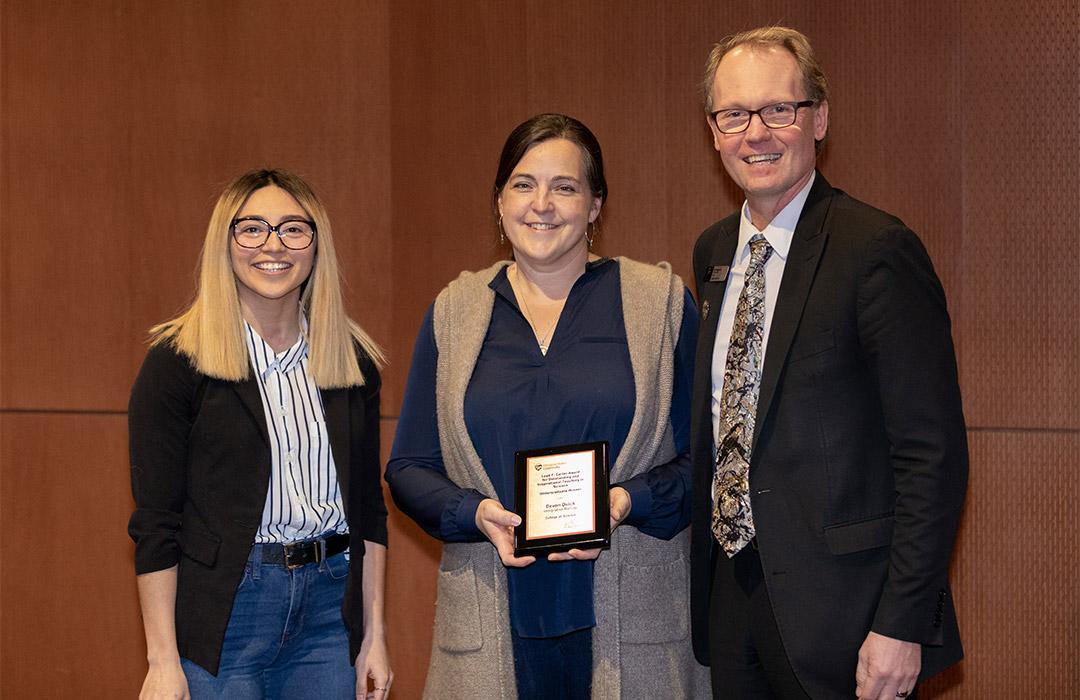
Devon Quick poses with award with microbiology student Arisa Larmay (left) and Dean Haggerty (right)

Biology instructor Devon Quick (center) with microbiology student Arisa Larmay (left) and Dean Haggerty (right)

Loyd F. Carter Award for Outstanding and Inspirational Teaching (Graduate)

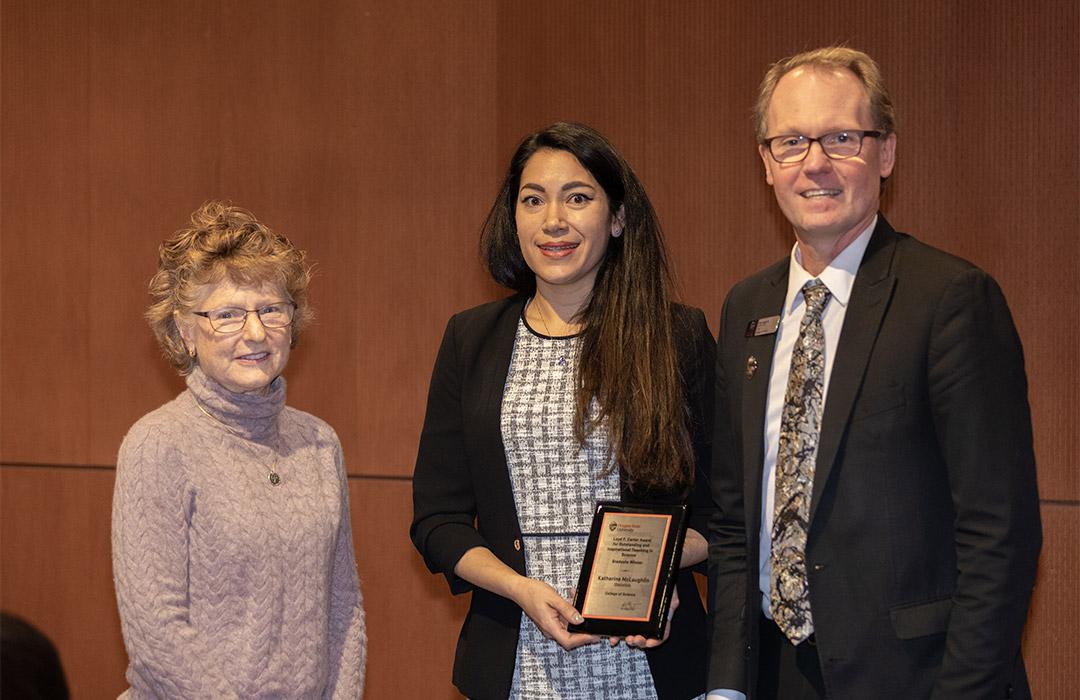
Assistant Professor of statistics Katherine McLaughlin received the Loyd Carter award for her inspirational and superb mentorship and teaching of graduate students. Statistics Department Head Lisa Ganio presented the award.

“Dr. McLaughlin is dedicated to teaching. She works hard to help her students understand course material and challenges them to think more deeply about problems. Her classroom is a welcoming environment to all,” wrote one student nominator.

“Her enthusiasm for the material is contagious and the thought and care that she puts into structuring her student's learning has far surpassed any other course I've taken,” wrote another nominator.

David Ji and Claudia Maier, both from the Department of Chemistry, also received multiple nominations for this award.

Katherine McLaughlin poses with award with Lisa Ganio and Dean Haggerty

Statistics Assistant Professor Katherine McLaughlin (center) with Statistics Department Head Lisa Ganio (left) and Dean Haggerty (right)

Frederick H. Horne Award for Sustained Excellence in Teaching Science

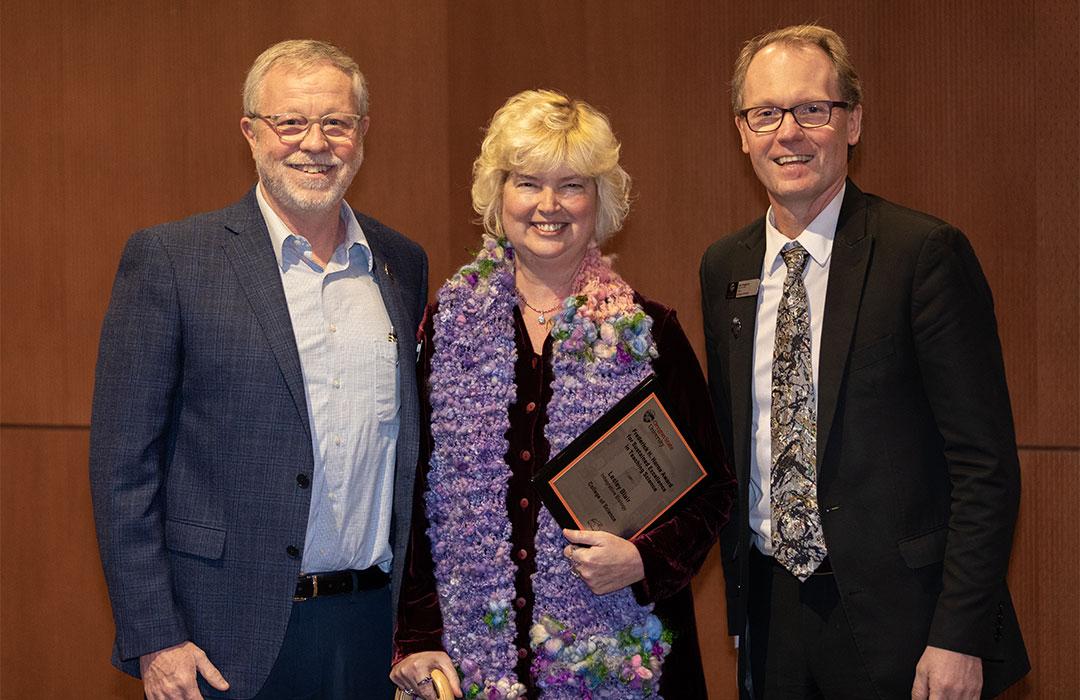
Lesley Blair won the Frederick H. Horne Award for her exceptional qualities as a teacher and mentor. Blair was hired by Dean Fred Horne as a full-time biology instructor in 2002. She primarily serves as the course coordinator and sole lecturer for the high enrollment – up to 800 students per quarter! – non-majors biology year-long series (BI 101 – 103). These are the Baccalaureate Core courses that the majority of non-life sciences students at OSU take to fulfill their science requirements. Blair has since transformed this course by aligning the content to best engage her students and make science relevant to their lives, inspiring them to be lifelong learners. She has also become the model for incorporating cutting-edge tools, technologies and approaches to learning for large format classes, teaching-in-the-round pedagogies developed for LiNC 100, OSU’s state-of-the-art Learning Innovation Center which houses 600-seat arena classrooms for large-format lecture science courses.

Lesley Blair poses with her award against wooden wall with Bob Mason and Roy Haggerty

Biology instructor Lesley Blair (center) with Biology Professor Bob Mason (left) and Dean Haggerty (right)

As part of her efforts to engage more students and the general public in science, Blair co-developed a website called Vivid Science, which links art and design with science teaching to build science literacy and break down barriers between the public and scientists. “Dr. Blair’s creative and tireless drive to innovate, improve and reach out to non-scientists is truly exceptional,” said Bob Mason, distinguished professor of biology, who presented the award. "She truly is helping to make all of our students scientifically literate and able to participate as knowledgeable and informed citizens. This is the very essence of the Baccalaureate Core and we are fortunate to have such a leader in the effective teaching of science to non-majors.”

Congratulations, Lesley! Thank you for your dedication and passion to inspire the next generation of informed, curious and engaged citizens.

Additional photos from the 2020 Winter Teaching and Advising Awards Ceremony

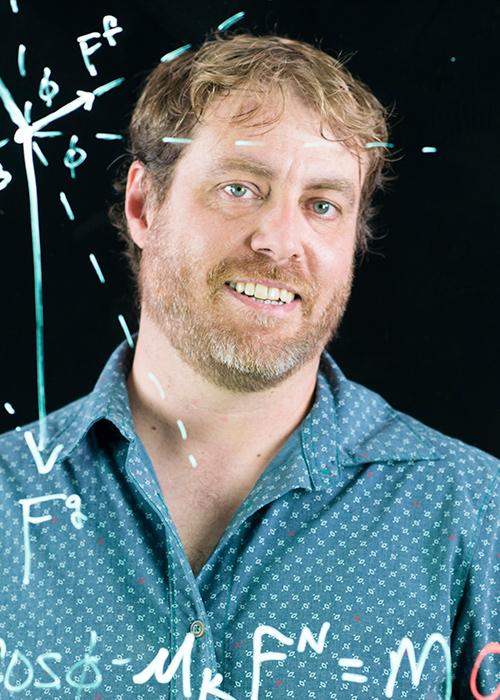
James Molyneux standing in front of Kidder Hall

Statistician who helped create new data science curriculum for California high schools joins OSU

By Srila Nayak

James Molyneux, assistant professor in statistics

The College of Science welcomes James Molyneux, who joined the Department of Statistics as an assistant professor in Fall 2018. Molyneux joined the department from UCLA, where he completed his dissertation on earthquake forecasting models based on statistical and computational methods.

In his new role, Molyneux teaches a wide variety of undergraduate and graduate courses, including online courses, to both statistics students and those from majors in engineering and biological sciences in the areas of data analytics, statistical methods and theory.

In addition to research on statistical seismology, Molyneux brings deep expertise in statistics pedagogy and education to OSU. As a doctoral student, he collaborated with his professors, high school educators, and other graduate students to create a project on statistics education funded by the National Science Foundation. The result is an innovative Introduction to Data Science (IDS) curriculum, which introduces high school students to data and statistics.

Part of a math-science partnership grant between UCLA and the Los Angeles Unified School District, IDS has been designated as a core math course and has been implemented in 14 southern California high school districts with further plans of scaling it to other school districts in the United States and even abroad.

A revolutionary approach to 21st-century mathematical learning, the year-long course engages students with real data, introducing statistical, computational and graphical tools for reasoning about the world.

Molyneux is excited about exploring the possibility of introducing Oregon high school students to data, statistics and coding through IDS. He had an opportunity to introduce the IDS program to the Oregon Department of Education during a Math Pathways seminar in December.

“There has been a lot of interest in changing how mathematics is taught in high schools in Oregon,” observed Molyneux. “What if we didn’t make every student learn calculus, and introduced them to data science instead?”

In recent times, educators have begun to question the longstanding tradition of high school mathematics curriculum, whose mainstays have been the much-feared algebra II and calculus courses, arguing in favor of multiple math pathways towards graduation and college, which would include new courses in data science, statistics and programming.

“I think students find a lot of utility and value in being shown how to type instructions to a computer in a coding language, hit enter and have something happen based on what they are writing. It teaches them a lot of fundamental statistical ideas and how to be a good citizen by learning to evaluate data critically and detect misrepresented graphs and data,” said Molyneux.

Molyneux eagerly looks forward to utilizing his experiences and background in statistics pedagogy in the classroom. His teaching is also guided by his own experience of transformation.

An indifferent student of mathematics during his undergraduate years at California State University, Fullerton, Molyneux’s academic interests underwent a radical metamorphosis when he crossed paths with a brilliant teacher in a calculus II class.

“I had barely passed calculus I, but my teacher — Kathy Lewis — changed everything for me. That’s when I thought for the first time math is for me.” The realization prompted him to add a major in mathematics along with his major in economics, which eventually led to several classes in statistics and a Ph.D. in statistics.

“Having come from a place where I did not initially like math, I really want to expose people to this field I fell in love with and why they may like it too. You can do powerful things with statistics; it has real-life applications. Enabling students to find meaning in statistics has a lot of value for me,” said Molyneux.

He is excited to collaborate with statistics colleagues and others on campus on several new projects. Some of these include creating software for hydrologists and joining forces with OSU’s Center for Genomics Research and Biotechnology to fashion a data science program for students from rural communities in Oregon, which will impart skills in data analytics and statistical applications in natural resources and agriculture.

“I am delighted to be here. The department has a data analytics program which is growing fast and it’s very fulfilling to be a part of it. The statistics faculty are incredible teachers and researchers. It has definitely been a highlight to get to do statistics with so many talented people,” said Molyneux.

A native of La Habra, California, Molyneux enjoys hiking, cycling and discovering the restaurants in Salem, Ore., where he resides. He harbors a dream to reach the summits of all the mountains in Oregon.

Javier Rojo sitting in office space

Statistician receives national award for building diversity, exceptional mentoring

Korvis Professor of Statistics Javier Rojo

Korvis Professor of Statistics Javier Rojo is the recipient of the 2018 Dr. Etta Z. Falconer Award for Mentoring and Commitment to Diversity. Dr. Rojo will receive his award at the Infinite Possibilities Conference (IPC) on April 14 at Howard University in Washington, D.C. The award recognizes individuals who have demonstrated a professional commitment to mentoring and increasing diversity in the mathematical sciences.

Rojo joined OSU's Department of Statistics as the inaugural Korvis Professor of Statistics in January 2017. The professorship is supported by statistics alumnus Rich Carone, CEO of Korvis Automation, a leading technology and manufacturing company based in Corvallis with offices in Singapore and Shanghai. The position supports OSU science faculty in physics or quantitative sciences to help advance research in the field of statistics and in the world of science more generally.

Rojo leads and directs the nationally recognized Research for Undergraduates Summer Institute of Statistics (RUSIS), which was selected by the American Mathematical Society for its award "Mathematics Programs That Make a Difference." RUSIS was honored as a model program for encouraging undergraduates to pursue graduate studies in the mathematical sciences and for increasing the numbers of underrepresented minorities and women in mathematics and statistics.

Funded by the National Science Foundation and the National Security Agency for the last 15 years, RUSIS is the country’s first Research Experiences for Undergraduate (REU) Program in the field of statistics. It has a highly successful track record in recruiting, training and guiding underrepresented minority and economically disadvantaged students towards advanced degrees in mathematics and statistics.

The Institute conducts a 10-week intensive summer program for the study of statistics and its applications for a cohort of 12-15 students every year. Under Rojo’s leadership, the program has taken phenomenal strides: After 10 years, the REU program reported that 85% of the undergraduates who attended the Summer Institute were admitted to Ph.D. programs around the country, with roughly 61% of students hailing from underrepresented populations and 53% of the participants have been female.

Rojo has been commended by both students and colleagues for his exceptional dedication to mentoring and teaching in the field of statistics leading to highly positive outcomes.

"As a first-generation college graduate and female in the field of statistics, the RUSIS program has greatly influenced the type of person that I am. Dr. Rojo taught me how to collaborate, be adaptable, well-rounded, and gave me confidence in my research and work. I feel that the RUSIS program laid the foundation for me to be a strong competitor upon entering graduate school. Today, I attribute my success in both undergraduate and graduate school, as well as my career to Dr. Rojo’s RUSIS program," writes a RUSIS alumna.

In an appreciative tribute, a colleague writes:

"One of the amazing things about RUSIS is that Javier is willing to take risks; he is willing to accept students who don’t have a great GPA or who do not have a substantial background in mathematics. Yet his data are enviable and show that, in spite of this, his RUSIS graduates are pursuing postgraduate studies. I have heard over and over again from the students that I send to RUSIS that it was an amazing experience."

Falconer was an educator and mathematician and one of the first African-American women to receive a Ph.D. in mathematics. A professor of mathematics at Spelman College and Norfolk State University, Falconer once said, "My entire career has been devoted to increasing the number of African-American women in mathematics and mathematics-related careers." Over the course of Falconer’s tenure at Spelman College, the number of women majoring in science, mathematics, and engineering tripled to nearly 40 percent of the student body.

The IPC is a national conference that is designed to promote, educate, encourage and support women of color interested in mathematics and statistics. IPC 2018 is organized by the Mathematical Sciences Research Institute in Berkeley, California, with funding from the Mathematical Sciences Institutes Diversity Initiative, a NSF program.

Read more about Javier Rojo and RUSIS.

student and mentor studying section of soil

Online Environmental Sciences program ranked No.2 in country

By Srila Nayak

On campus environmental science bachelor program

“The History of Life on earth has been a history of interaction between living things and their surroundings,” writes Rachel Carson in her environmental classic Silent Spring (1962). An education in Earth’s natural and physical environments and their interrelationships is at the foundation of the top-ranked interdisciplinary Environmental Sciences undergraduate program at Oregon State.

Global warming, species extinction, air and water pollution, natural resource depletion, and renewable energy demands are rapidly changing the world we live in. These developments require the expertise and knowledge of environmental scientists who can assess, tackle and mitigate environmental challenges as well as help preserve a healthy natural environment. According to the Bureau of Labor Statistics, employment of environmental scientists is projected to increase 11 percent from 2016 to 2026.

Housed in the College of Earth, Ocean and Atmospheric Sciences, Oregon State’s online and on campus environmental sciences bachelor program is setting high standards for excellence. U.S. News & World Report features OSU in its top 40 programs for Best Global Universities for Environment/Ecology, awarding it a rank of 36 amongst similar programs worldwide.

The online program in environmental sciences was ranked No. 2 in the nation by Online Colleges in its ranking for Best Online Colleges for Environmental Science in 2018. For its rankings, Online Colleges “collected data from the National Center for Education Statistics’ Integrated Postsecondary Education Data System (IPEDS) and utilized a custom methodology to ascertain the ten best schools for environmental science in the United States.”

Students can earn an environmental sciences degree both on campus and through online courses, which are taught by Oregon State faculty, many of whom are in the College of Science. The online bachelor of science degree in environmental sciences is offered by OSU’s award-winning Ecampus. With a focus on eco-oriented programs as well as a broad swath of fields from anthropology to computer science, OSU Ecampus has racked up top place rankings in almost every prestigious survey of online degree programs. Since 2014, U.S. News & World Report has ranked OSU Ecampus in its top 10 online bachelor’s programs.

Breaking down boundaries: An interdisciplinary approach

One of the great strengths of environmental sciences at OSU is undoubtedly its interdisciplinary character. The program emphasizes the biological, physical, earth and natural sciences as well as the integration of social sciences that cover a wide range of subject areas from ethics to environmental law, policy and management.

Director of the Environmental Sciences Program Laurence Becker explains that the program offers a broad base in the sciences with a great deal of academic flexibility for students who love the environment and desire a broad exposure to both science and environmental law and policy.

An attractive feature of the program is that students can choose from one of nine options that range from studies in alternative energy and environmental science education to earth systems and environmental water resources. The most popular options are applied ecology and conservation, resources and sustainability.

In addition, the major offers two certificates: one in the popular field of geographic information science (GIS) and the other in scientific, technical and professional communication. All of the specializations are available online through Ecampus except alternative energy and environmental science education.

More often than not students discover their vocation as they experience different facets of environmental science training in this nontraditional program.

“This program allows them to remain open to different job opportunities and different areas of environmental science they are exposed to in their undergraduate career. The broad degree allows students to shift along the way if needed and many discover interests they wouldn’t have dreamed of in the beginning,” said Becker.

The science in environmental sciences

Science is a foundation for the degree because environmental studies majors need the scientific aptitude to apply complex concepts in biology, chemistry, mathematics and physics in order to understand challenging environmental issues and seek solutions. Quantitative coursework in differential, integral calculus and statistical methods prepare students to design research models and employ analytical tools to study and assess the environmental impact of development projects and businesses.

The bachelor of science degree in Environmental Sciences requires all students to complete a full year of basic science courses in biology and chemistry, as well as courses in calculus, statistics and physics.

The environmental sciences curriculum comprises many core courses that are taught in the College of Science. It offers students different specializations in the program as well as a rigorous foundation in theoretical and experimental upper-level science courses, including:

  • Ecology (BI 370), which is central to the degree program
  • Marine ecology
  • Ecological methods
  • Animal behavior
  • Human ecology
  • Conservation of marine mammals
  • Modern chemical analysis, among others.

For example, a specialization in aquatic biology comprises coursework in a diverse and exciting mix of courses in marine and invertebrate biology offered by the College of Science, oceanography in the College of Earth, Ocean and Environmental Sciences and courses in biological resources at the College of Forestry.

The strong presence of science in the basic, core and specialized components of the Environmental Sciences program enhances both its rigor and cross-disciplinary power.

Develop expertise that makes a difference to all

An experiential learning requirement offers students the opportunity to complete an environmental science related internship, research project, field course or a study abroad experience.

Becker points out that online students are encouraged to pursue internships; on-campus students often undertake research projects or internships.

The experiences often turn out to have a lasting impact on student careers, explains Becker. Students discover opportunities to pursue significant internships in the areas of hydrology, wildlife management, conservation science, biochemistry and geoscience across local and federal government agencies, research centers, environmental consulting firms and not-for-profit organizations. It is not unusual for quite a few of them to translate into longer-term opportunities and job offers.

The broad versus the narrow

Becker often meets parents of prospective students who are nervous about job prospects within a broad field of study.

“The program’s training in science and social science cultivates a broad knowledge of natural sciences with ethics and policy. We often attract students from more specialized majors such as engineering who don’t feel comfortable in a narrower choice of subjects and are motivated by a deep love for the environment.”

The most attractive feature of the degree is the wide variety of careers it throws open for graduates. Environmental scientists can work in local government, private companies, law firms, not-for-profit groups or government agencies such as the Environmental Protection Agency, the National Park Service, or the United States Geological Survey. Students also get into competitive law school programs and other graduate programs in the sciences and policy.

Due to the unique constellations of quantitative, analytical and research skills in addition to writing and communication abilities that they acquire from the interdisciplinary curriculum, environmental science students find themselves well suited to a diverse range of jobs across environmental science, policy, education and consulting firms.

“It is incumbent on us as advisors and teachers to help students find something that they are passionate about,” said Becker.

Each year Becker invites seniors and recent alumni to speak to first-year students in his Environmental Sciences Orientation class. During a recent visit, a talented environmental sciences alumnus who was also a ROTC (Reserve Officers Trainings Corps) graduate at OSU, shared insights gleaned from his professional journey.

He had easily found employment, working at positions related to the field of environmental sciences that were nonetheless very different from one another. A fourth job change landed him an enviable position in the Oregon National Guard where he leads the environmental management of their facilities.

The alumnus had a message about the enduring advantages of an environmental sciences degree: “The degree because of its breadth allowed me to apply for jobs that I hadn’t worked in.”

“Having this broad background allowed for a possibility of change when the opportunity arose,” added Becker.

Given the rising demand for experts in the field, OSU environmental scientists will be having an impact on the world around us for many decades to come.

Science students with professor looking at experiment in lab

Science students awarded second highest number of scholarships at OSU

By Steve Lundeberg

Science students in the field

The university has awarded more than $39.5 million in scholarships to students for the 2017-18 academic year, a key component of OSU President Ed Ray’s Student Success Initiative.
Roughly $24.5 million of the total is spread among 7,271 scholarships to returning students. The rest is for awards to 2,532 new/incoming students, including 34 who received a $10,000-per-year Presidential Scholarship, OSU’s most prestigious undergraduate scholarship.
Approximately 35 percent of this year’s first-year students are receiving scholarship support.

Scholarships for science students at an all-time high

College of Science students received the second highest amount of scholarship funds in the university.

More than $7.5 million in scholarship money is going to College of Science students, the college’s highest total ever, said Roy Haggerty, dean of the college. That is triple the amount awarded two years ago. Reasons for the jump include increases in university scholarships and in the number of high-achieving students enrolling in the College.

Nearly $5 million is allocated to 1,344 scholarships for returning students. The rest is for awards to 570 incoming/new students, including nine who received a Presidential Scholarship.

This year more than half of the college’s first-year students received scholarship support.

“Scholarships enable the college to attract, retain and inspire top science students, most of whom go on to high-achieving careers in industry, graduate school, medical school and other professional programs after graduation,” Haggerty said.

“Oregon State’s financial-need-based scholarships also help academically talented low-income and first-generation students from Oregon and elsewhere stay and excel in college.”

First-generation students typically have a greater financial need so scholarships are a crucial part of their educational equation, said Haggerty, who was first in his family to attend college.

“In our College, the number of first-generation students has risen from 20 percent to 29 percent in the last five years,” he said. “Many scholarship students in the College of Science attest to the value of scholarships in easing the financial burden on their families and enabling them to focus on academics, research, volunteer activities and post-college career goals.”

College of Engineering netted the highest amount in scholarship support. Thirty-five percent of engineering students are receiving scholarship support. They are receiving $12.7 million, with $7.9 million divided among 1,948 scholarships to returning students. Nineteen of the 804 their incoming scholarship students are Presidential Scholars.

In third place is the College of Business. It was awarded more than $3.7 million in scholarships, including roughly $2.3 million spread among 761 scholarships to returning students. The remainder is awarded to 276 incoming students, including one Presidential Scholar. About 29 percent of this year’s first-year business students are receiving scholarship support.

Subscribe to Teaching Innovation